How it all started? - Seven Bridges of Königsberg
So let's look at the introduction of graph theory in real world. So it started from Russia. There is a Russian city called Königsberg. It has seven bridges which are constructed to connect two Islands.
The concern about these bridges was that the people would have to walk through the city by crossing all the seven bridges and you can only be walking one bridge at a time. So let us look at the picture given below
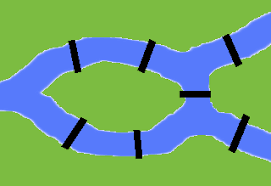
So to solve this problem first of all we cannot skip any bridge and we can only cross a bridge once.
A lot of people tried but this puzzle seemed impossible to them.
So a Russian mathematician Leonard Euler tried to solve this and came up with a reason that why this is such a hectic job.
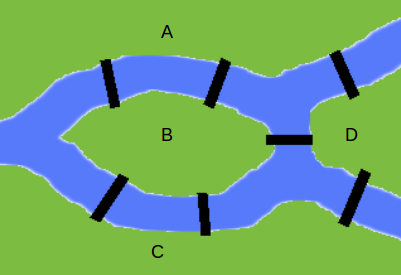
In the image as we can see there are four different lands and two Islands (b and d). Two parts of the mainland (a and c) and total seven bridges.
Each land is connected with an odd number of bridges as shown in the figure.
We can break down this image and can form a number of conclusions. So firstly each land is connected with an odd number of bridges. If we wish to cross each bridge only once then you can enter and leave a land only if it is connected to an even number of bridges.
In simple words, we can say that if there are even number of bridges it is possible to crack this puzzle while it's impossible to crack this with odd number of bridges.
So let's add another bridge in the image and see if we can solve this puzzle
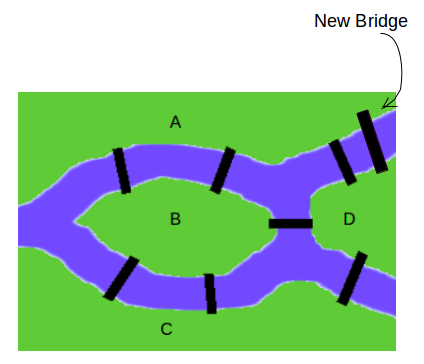
Now we have 2 lands which are connected with even number of bridges and 2 lands which are connected with odd number of bridges.
Now let's draw a new route after adding the new bridge.
But adding a new bridge solved the problem completely!
So you might be wondering if the number of bridges are significant to solve this problem?
Do the bridges have to be even every time?
Well the answer is no.
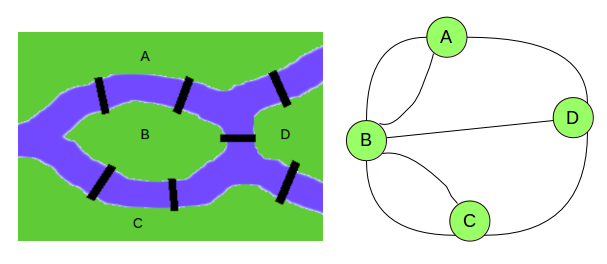
The mathematician explained that with the number of bridges, the number of pieces of land with an odd number of connected bridges are significant as well. He converted this problem from land and bridges to graphs, where he represented the land as vertices and the bridges as edges of the graph as shown below.

🙌🏻
ReplyDelete